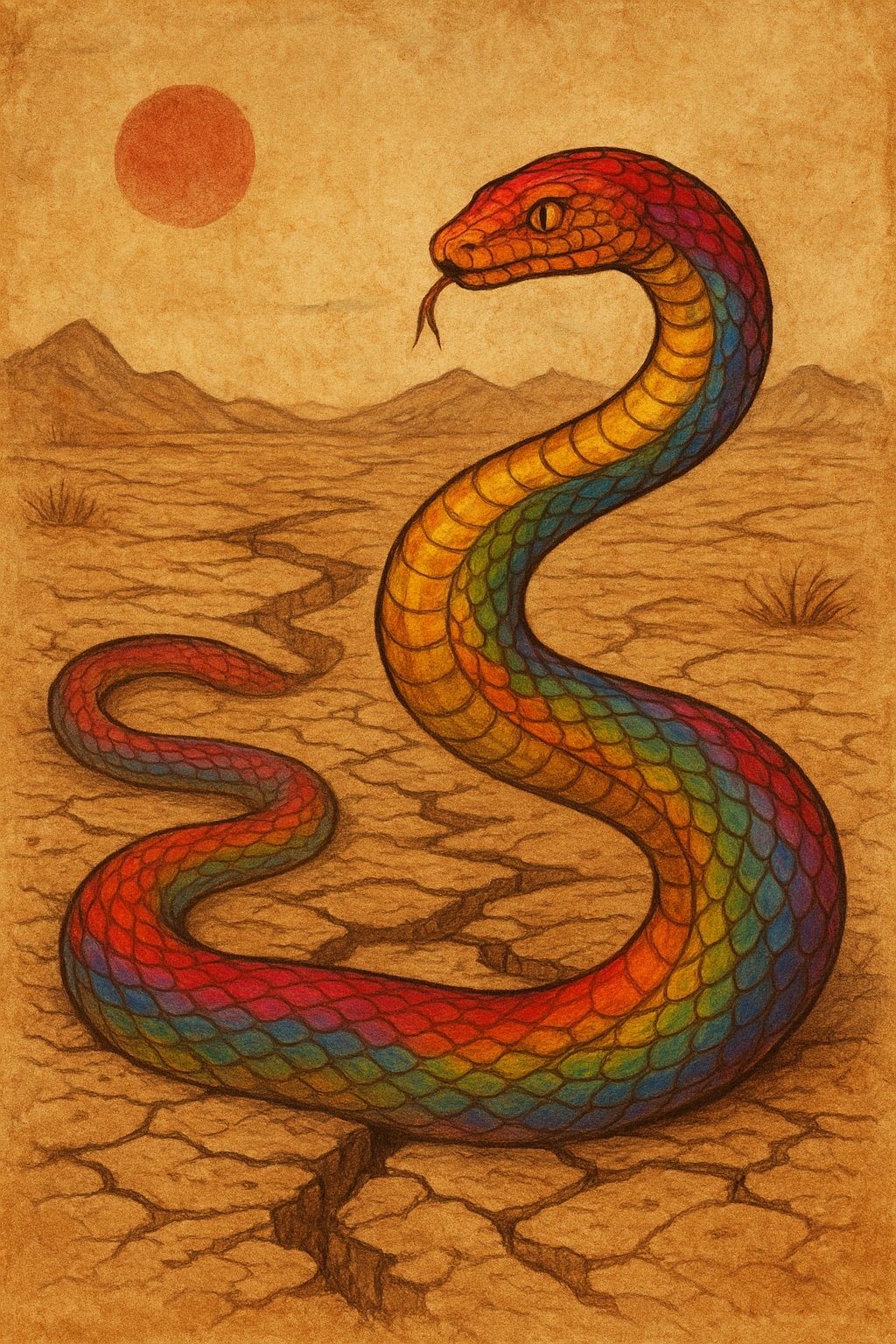
In the time before water flowed across the land, the earth lay parched and broken beneath an unforgiving sun. The East Sepik region of Papua New Guinea, which today bursts with green abundance and rushing streams, was then a place of endless thirst. The ground cracked open like old pottery, revealing deep fissures that led down into darkness. The people suffered greatly, walking for days to find even a handful of muddy water trapped in stone hollows. Plants withered before they could bear fruit, and the animals grew thin and desperate, their eyes reflecting the same aching need that haunted every living thing.
The elders gathered in what little shade they could find and spoke in hushed, reverent tones of a power that slept deep beneath the earth a being of unimaginable strength and beauty who had existed since the world’s first breath. They called her the Rainbow Snake, though no living person had ever seen her. She was said to rest in vast chambers far below the surface, coiled in the cool darkness, waiting for the moment when the world above would need her most.
Click to read all Melanesian Folktales — rich oral storytelling from Papua New Guinea, Fiji, Solomon Islands, and Vanuatu
That moment had come.
One morning, as the sun rose blood-red over the cracked landscape, the earth began to tremble. It started as a gentle vibration, like the distant beating of ceremonial drums, but quickly grew into a powerful shaking that knocked people from their feet and sent stones tumbling from the hills. The people cried out in fear, clutching their children and each other, certain that the world itself was breaking apart.
Then, from a great split in the earth near what would become the Sepik River, she emerged.
The Rainbow Snake rose from the depths like dawn breaking over the ocean. Her body was beyond measure thick as the mightiest tree trunks, long enough to stretch across entire valleys. But it was her scales that stole the breath from every witness. They gleamed with colors more vivid than anything the parched world had known deep crimson like the heart of fire, brilliant gold like captured sunlight, sapphire blue like the sky on the clearest day, emerald, green like the forests of distant memory, and purple like the rarest orchids that once grew in better times.
Each scale caught the light and threw it back transformed, so that the Rainbow Snake seemed to glow with an inner radiance, as if she carried within her body all the beauty that had fled from the dying land. Her eyes were ancient and knowing, holding depths that spoke of wisdom accumulated over countless ages. When she moved, her scales created a sound like wind chimes made of seashells, musical and strange.
The Rainbow Snake did not pause to rest or survey the ruined landscape. She knew what needed to be done, for she had felt the suffering of the land through the very stones that surrounded her sleeping place. With purposeful grace, she began to move across the territory, and where her massive body touched the earth, transformation followed.
Her powerful form carved deep into the ground, her scales grinding against stone and soil, creating channels and valleys that had never existed before. She wound through the landscape like a living river herself, her path following the natural contours of the land, finding the places where water would most want to flow. The grooves she left behind were smooth and deep, perfect pathways waiting to fulfill their destiny.
When she had carved the great network of valleys and channels across the East Sepik region, the Rainbow Snake turned toward the distant sea. The people watched in wonder as she traveled, her brilliant body leaving a trail of prepared riverbeds in her wake. When she finally reached the ocean, she lowered her magnificent head and began to drink.
She drank deeply, pulling the salt water into herself in great swallowing gulps that seemed to drain entire portions of the sea. Her body swelled with the volume of water she consumed, her scales stretching to accommodate the ocean she now carried within. Then, still glowing with her rainbow radiance, she turned back toward the land.
The Rainbow Snake retraced her path, following the valleys and channels she had carved, but now she was transformed into something even more miraculous. From her mouth, from between her scales, from every part of her water-filled body, fresh water began to flow. The salt had been transformed within her into pure, life-giving freshwater that spilled out in streams and torrents, filling the channels she had made.
Behind her, the dry riverbeds awakened. Water rushed and tumbled, finding its way into every groove and depression, spreading out to create not just rivers but lakes and pools and wetlands. The sound of flowing water absent for so long it had become a half-forgotten dream filled the air like the most beautiful music ever heard.
The transformation was immediate and glorious. The cracked earth drank gratefully, plants burst into sudden green life, and animals emerged from hiding places to lap at the edges of the new rivers. The people fell to their knees, weeping with joy and gratitude, watching as their dying land became a paradise of water and growing things.
When her work was complete, the Rainbow Snake returned to the place where she had first emerged. The people had followed her, bringing gifts of gratitude the finest carvings, the most beautiful woven bags, offerings of food and carved shells. They declared her the Mother of Rivers and vowed to honor her forever.
In celebration, the Abelam people began to decorate their ceremonial houses with her sacred colors. They painted the tall gable facades with brilliant reds, golds, blues, greens, and purples, creating intricate patterns that echoed the Rainbow Snake’s magnificent scales. These haus tambaran spirit houses became temples to her memory and gifts, adorned with her colors so that all who saw them would remember what she had done.
For a time, harmony prevailed. The people lived gratefully beside the rivers, fishing in their waters, growing crops in the fertile soil along their banks, and teaching their children the story of the Rainbow Snake who had saved them all.
But as seasons passed and new generations grew up knowing only abundance, something began to change. Arguments started over which village had rights to which sections of river. Families claimed ownership of particular fishing spots. Communities built barriers to direct water toward their own gardens and away from their neighbors’. The sacred gift became a source of conflict and greed.
“This river flows through our land, so its fish belong to us!” one group would shout.
“But it comes from the hills above our village we should control how much water you receive!” another would answer.
The disputes grew bitter and violent. The people who had once wept together in gratitude now raised spears against each other, fighting over the very blessings that had saved them.
The Rainbow Snake, who had been resting peacefully in her underground chambers, felt the discord vibrating through the earth. She felt the selfishness and anger, so different from the desperate hope and gratitude she had answered before. Her ancient heart grew heavy with disappointment.
One morning, the people woke to find a thick mist covering the land. Through the fog, they caught glimpses of rainbow-colored light moving upward, and they knew the Rainbow Snake was leaving. She rose from the earth one final time, but now she did not stop at the surface. She continued rising, her glorious body spiraling up into the sky, climbing higher and higher until she disappeared into the clouds.
The rivers remained her gift was not withdrawn but the Rainbow Snake herself was gone. She left behind only one sign of her continued presence: when rain falls and sunlight breaks through the clouds, a rainbow appears in the sky, arching across the heavens in the same brilliant colors that once adorned her scales. It is her promise that she has not forgotten the people, and perhaps, if they can remember gratitude and sharing, she may one day return.
Even now, the Abelam people paint their ceremonial houses in her sacred colors and tell their children the story of the Rainbow Snake. They teach that the rivers are gifts to be shared, not possessions to be hoarded, and that when people see a rainbow, they should remember both the blessings they have received and the selfishness that can drive those blessings away.
Explore tales of ancestral spirits and island creation that connect people to the land and sea
The Moral of the Story
This ancient Abelam legend teaches us that nature’s gifts are sacred and must be treated with gratitude and shared generously. The Rainbow Snake’s departure reminds us that selfishness and greed over communal blessings can cause us to lose not just the giver’s presence, but also the harmony and abundance that come from treating sacred gifts with the reverence they deserve. When we fight over what should unite us, we risk losing the very things that sustain us.
Knowledge Check
Q1: What was the East Sepik region like before the Rainbow Snake appeared?
A1: Before the Rainbow Snake emerged, the East Sepik region of Papua New Guinea was a parched wasteland with cracked, dry earth and no rivers. The people and animals suffered from extreme thirst, walking for days to find even small amounts of water. Plants withered and the land was dying under an unforgiving sun, with deep fissures splitting the ground.
Q2: How did the Rainbow Snake create the rivers in Papua New Guinea?
A2: The Rainbow Snake carved deep valleys and channels across the land with her massive body, grinding through stone and soil to create pathways for water. She then traveled to the ocean, drank enormous amounts of seawater, and transformed it within her body into fresh water. As she retraced her path, she released this purified water, filling all the channels she had carved and creating rivers, lakes, and wetlands throughout the region.
Q3: What do the Rainbow Snake’s colors symbolize in Abelam culture?
A3: The Rainbow Snake’s scales displayed vivid colors red, gold, blue, green, and purple that represented life, beauty, and sacred power. The Abelam people honored these colors by painting them on their ceremonial houses (haus tambaran), creating a permanent tribute to the Mother of Rivers. These colors serve as a reminder of her gift and the beauty she brought to their previously barren land.
Q4: Why is the Rainbow Snake called the Mother of Rivers by the Abelam people?
A4: The Abelam people named her the Mother of Rivers because she literally gave birth to all the rivers and water sources in their region. She not only created the physical channels for water to flow but also provided the water itself, transforming ocean water into fresh, life-giving streams. She saved the people, animals, and plants from death by thirst, nurturing the land like a mother nurtures her children.
Q5: What caused the Rainbow Snake to leave the earth in this Papua New Guinea legend?
A5: The Rainbow Snake departed because the people began fighting over ownership of the rivers she had created. Instead of sharing the water as a communal blessing, villages and families quarreled about who controlled which sections of river and fishing spots. Their selfishness, greed, and violence over her sacred gift disappointed her so deeply that she withdrew from the earth and ascended into the clouds.
Q6: What is the significance of rainbows in Abelam mythology?
A6: In Abelam tradition, rainbows are the Rainbow Snake’s promise that she has not completely abandoned the people. When sunlight breaks through rain clouds to create a rainbow, it displays her sacred colors in the sky, reminding people of her gift and her continued watchfulness. The rainbow serves as both a memorial to her presence and hope that if people can return to gratitude and generosity, she might one day come back.
Source: Oral accounts recorded among the Abelam by anthropologist Anthony Forge in Art and Environment in the Sepik (Royal Anthropological Institute, 1966) and corroborated by Myths and Legends of Papua New Guinea by M. H. Holbeck (University of Papua New Guinea Press, 1975).
Cultural Origin: Abelam People, East Sepik Region, Papua New Guinea