In the time of the old gods, when the Hawaiian Islands were still watched over by ancestral spirits and every wind carried the breath of a deity, there lived a young princess named Naupaka. She was a daughter of a noble chief, born beneath the golden sun of Hawai‘i and beloved by her people. Her beauty was said to mirror the morning light, radiant yet gentle, as if touched by the first warmth of dawn upon the ocean waves.
Naupaka was graceful and wise beyond her years, often seen walking barefoot along the forest paths or sitting beside the sea, listening to the language of the waves. Her laughter was soft like the rustle of palm fronds, and her heart was filled with compassion for all living things. Though her lineage destined her for alliance with chiefs and gods, her spirit was drawn toward something far simpler, the world of ordinary people.
Discover how courage and cleverness shaped the storytelling traditions of Micronesia
It was during one of her visits to a seaside village that she met Kauʻi, a humble fisherman with kind eyes and a heart as vast as the ocean. He was known among the villagers for his honesty and his songs, melodies that echoed across the water as he cast his nets. When Naupaka first heard him sing, his voice carried the rhythm of the tides and the sorrow of those who lived by them. From that moment, the two souls were drawn together as surely as the moon pulls the waves.
Each day, Naupaka found reasons to return to the shore. She brought fruits from the upland groves and listened as Kauʻi spoke of the sea’s moods, the clouds that foretold storms, and the shimmering trails of fish beneath the surface. In his presence, she found peace. And in hers, he found reverence, not for her title, but for the spirit that shone from her eyes.
But theirs was a love forbidden. In those ancient times, the gods decreed that royal blood could not mingle with that of commoners. The union between a princess and a fisherman was taboo, a violation of sacred order. Even the winds whispered warnings through the palms: This love must not be.
When word of their affection reached Naupaka’s parents, the chiefs were filled with sorrow and fear. “Daughter,” they told her gently, “your heart is noble, but the laws of the gods cannot be broken. To do so would bring misfortune upon our land.”
Tears welled in Naupaka’s eyes, and for days she could not eat or sleep. The pain of her heart was like the breaking of waves upon black lava rocks, endless and unyielding. Finally, she and Kauʻi resolved to seek counsel from the kahuna, the wise priest who dwelled high in the sacred mountains.
Together they climbed through forests thick with ferns and the songs of hidden birds. The air grew cool and thin as they approached the temple at the mountain’s summit, where clouds touched the earth and the gods were said to listen more closely.
Kneeling before the kahuna, Naupaka cried, “We have come seeking the mercy of the gods. We ask only to be together in love and peace.”
The old priest closed his eyes, listening to the whisper of the winds and the murmuring of the forest. He prayed long and silently. Then, opening his eyes, he shook his head with great sadness. “The signs are clear, my children,” he said softly. “The gods do not permit this union. Your love is true, but it cannot dwell in one world. You must part, one to the mountains, one to the sea. In time, nature itself will remember your love.”
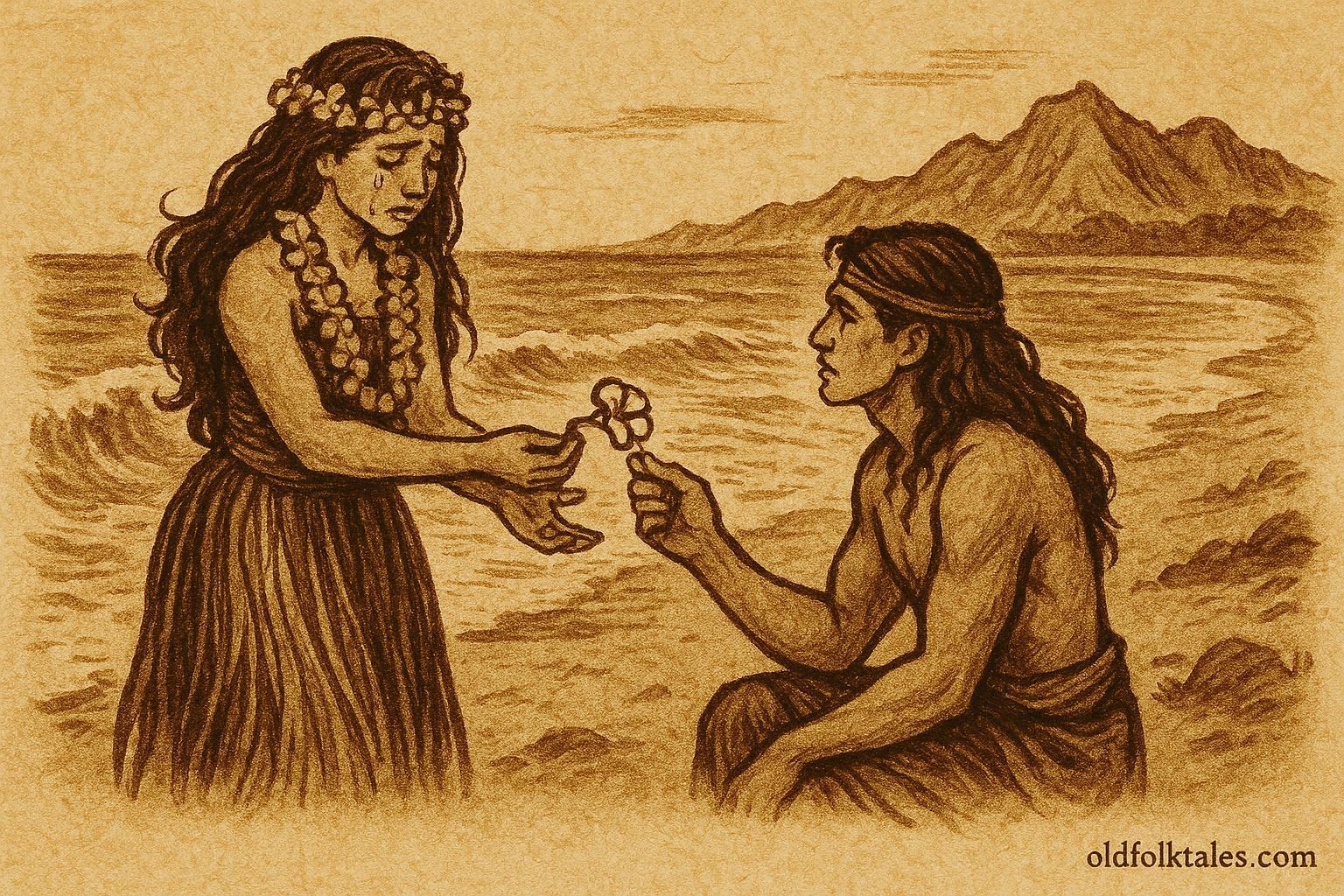
At these words, Naupaka felt her heart shatter. She looked to Kauʻi, whose face bore both sorrow and quiet strength. “If we must be apart,” she whispered, “let something of us remain joined.”
With trembling hands, she reached into her hair and plucked a single white flower, the naupaka, whose petals formed a perfect circle. Tearing it in two, she gave one half to Kauʻi and kept the other pressed against her heart.
“Take this to the sea,” she said, her voice breaking. “Plant it where the waves kiss the sand. I will plant mine in the mountains. Though we are divided, these flowers will remember.”
The lovers embraced one last time, the wind carrying their tears into the mist. Then Naupaka turned toward the uplands, climbing the path through the forest until she vanished among the ridges. Kauʻi descended to the shore, each step heavier than the last.
In the mountains, Naupaka knelt upon a rocky ledge and placed her half of the flower into the soil. She prayed that the gods would show mercy, that her love might not fade though the distance grew eternal. The rains fell softly around her, feeding the ground with her tears. From that sacred place, a new flower bloomed, its petals forming only half a circle, as though mourning what was lost.
By the sea, Kauʻi did the same. He pressed his half of the flower into the sand beside the tide pools, whispering Naupaka’s name to the waves. The ocean’s foam swirled around it, and soon another bloom appeared, also incomplete, mirroring the one in the mountains.
The gods, moved by their devotion, took pity. They allowed both flowers to thrive, one in the mountains, the other by the shore. But neither would ever form a full blossom. Each bore only half its petals, forever seeking the other. And so, across Hawai‘i, the naupaka kahakai (the seaside naupaka) and the naupaka kuahiwi (the mountain naupaka) grow as symbols of eternal love divided by divine decree.
To this day, the people of Hawai‘i say that when the mountain breezes meet the sea winds, the spirits of Naupaka and Kauʻi are near, whispering to each other through the air, remembering their love that defied even the gods. The sight of the half-flowers blooming on opposite worlds remains a living story: a tale of love’s endurance and the ache of what cannot be reunited.
Moral Lesson
The Legend of the Naupaka Flower reminds us that love, even when unfulfilled, leaves a lasting mark upon the world. True devotion transcends distance, time, and divine boundaries. Like Naupaka and Kauʻi’s blossoms, love that is pure endures, not through possession, but through remembrance.
Knowledge Check (Q&A)
- Who are the main characters in The Legend of the Naupaka Flower?
Princess Naupaka and the fisherman Kauʻi are the central figures whose love inspired the divided naupaka blossoms of Hawai‘i. - What do the mountain and seaside naupaka flowers symbolize?
They represent eternal love separated by fate, with each half-flower symbolizing the divided hearts of Naupaka and Kauʻi. - Why were Naupaka and Kauʻi forbidden to marry?
Because ancient Hawaiian divine law prohibited unions between royalty and commoners, their love was considered taboo. - What moral lesson does the Naupaka legend teach?
It teaches that love’s purity and remembrance can transcend separation, even when worldly or divine forces keep lovers apart. - Where are the two kinds of naupaka flowers found?
Naupaka kuahiwigrows in the Hawaiian mountains, while naupaka kahakaiblooms along the seashores, each mirroring the other’s missing half. - What cultural value does this Hawaiian folktale express?
The story emphasizes the Hawaiian reverence for nature as a vessel of emotion and memory, where love and loss are reflected in the living world.
Source: Adapted from Hawaiian Legends of Old Honolulu and Maui by W. D. Westervelt (1916).
Cultural Origin: Hawaiian (Polynesian)