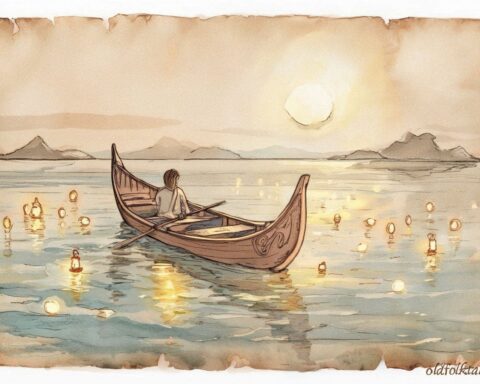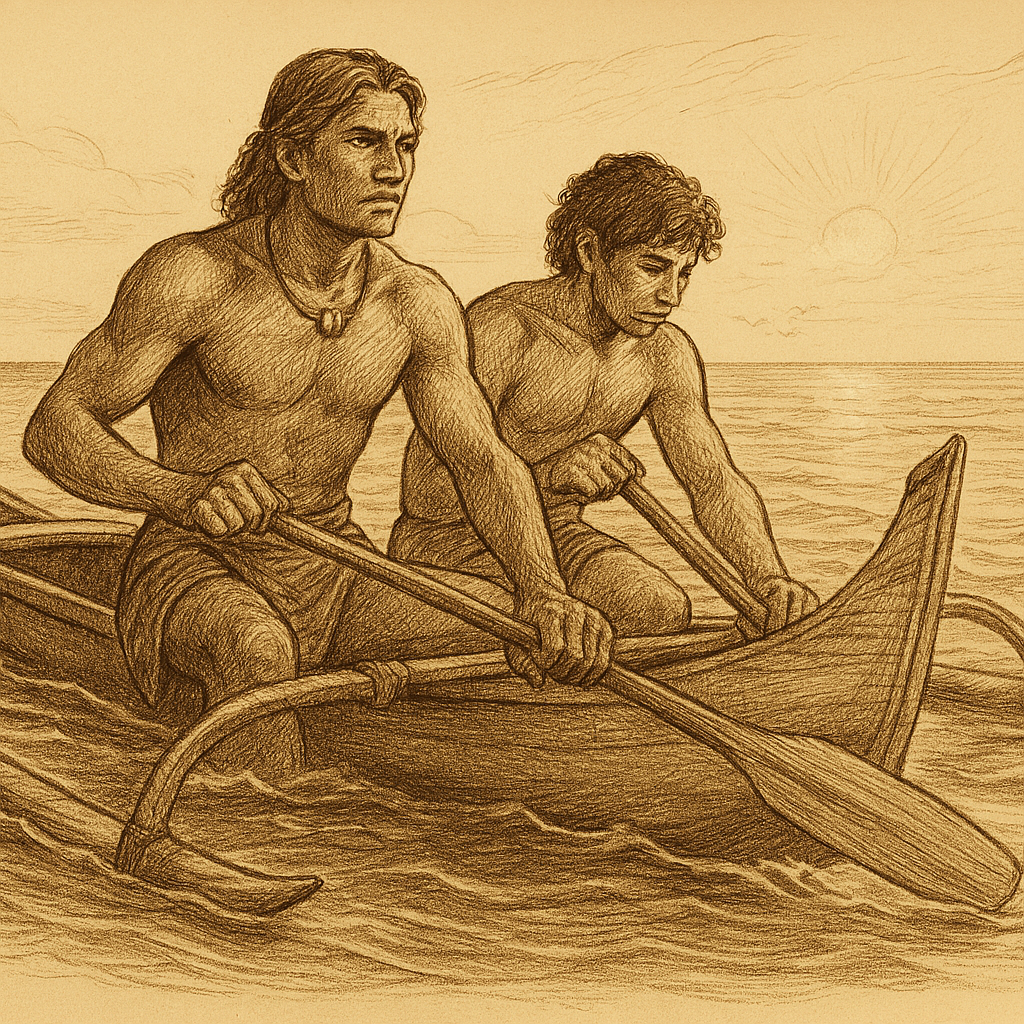
The sun had barely cleared the horizon when two brothers pushed their outrigger canoe into the gentle surf. The older brother sat at the stern, his paddle cutting through the water with strong, practiced strokes. The younger brother worked at the bow, matching his rhythm to his sibling’s movements. Together they propelled their vessel away from the familiar shore of their island home, heading toward the deep waters where the best fish could be found.
The morning was perfect for fishing. The sky stretched above them in an endless dome of brilliant blue, unmarred by even a wisp of cloud. The ocean swells rolled beneath their canoe in a steady, predictable rhythm large enough to carry them forward, gentle enough to pose no danger. Seabirds wheeled overhead, their cries echoing across the expanse of water, while flying fish occasionally burst from the waves in silver arcs that caught the early light.
Click to read all Melanesian Folktales — rich oral storytelling from Papua New Guinea, Fiji, Solomon Islands, and Vanuatu
The brothers paddled in comfortable silence, as men do who have worked together since childhood. They knew each other’s movements without speaking, understood when to paddle harder and when to rest. The older brother, as was his nature, kept his eyes fixed on the horizon, always focused on their destination, always thinking of the practical matters how many fish they would need to catch, how long the journey would take, whether the weather would hold.
The younger brother, by contrast, let his gaze wander across the water’s surface, noticing the play of light on the waves, the patterns of current and wind, the small signs that spoke of the ocean’s mood. It was this attention to detail, this tendency to observe rather than simply to act, that caused him to notice something the older brother had already passed by.
“Brother,” the younger one called out, lifting his paddle from the water. “Look there in the waves ahead.”
The older brother turned his head irritably, annoyed at the interruption of their steady progress. “What is it? We have far to go if we want to reach the fishing grounds before the sun grows too hot.”
“There’s something struggling in the water,” the younger brother insisted, pointing with his paddle. “Something alive.”
As they drew closer, they could see it clearly a heron, its elegant wings spread helplessly across the surface of the sea. The bird was exhausted, its feathers waterlogged and heavy, its long legs tangled in something they couldn’t quite see. It beat its wings weakly, trying to lift itself from the water, but each attempt only seemed to tire it further. The bird’s yellow eye fixed on the approaching canoe with what might have been hope, or perhaps just the blank stare of a creature too exhausted to feel anything but the approach of death.
The younger brother began to turn the canoe toward the struggling bird, but his older brother’s sharp voice stopped him.
“Leave it,” the older brother commanded, his tone brooking no argument. “It is only a bird. The ocean takes what it will that is the way of things. If we stop for every creature in distress, we will never reach the fishing grounds. Our family needs food, not the burden of a dying heron.”
The older brother’s words carried the weight of practical wisdom. They did have far to paddle. Their family did depend on the fish they would catch. Time spent rescuing a bird was time taken from their real purpose. These were all reasonable thoughts, all sensible considerations.
But the younger brother found he could not simply paddle past. Something in the heron’s struggle moved him perhaps the desperate beating of its wings, perhaps the proud arch of its neck even in exhaustion, perhaps simply the recognition that here was a living thing fighting for survival against overwhelming odds.
“I cannot leave it to drown,” the younger brother said quietly but firmly. “Continue on if you must. I will catch up after.”
The older brother made a sound of disgust and frustration, but he did not paddle away alone. Whatever his irritation, he would not abandon his brother in the middle of the ocean. So he held the canoe steady, shaking his head at this foolishness, while the younger brother carefully maneuvered closer to the struggling heron.
The rescue was not easy. The bird, frightened and exhausted, tried to peck at the hands that reached for it. Its wings, though weakened, were still large enough to slap against the younger brother’s face and arms. But with patience and gentle persistence, he managed to lift the heron from the water and bring it into the canoe.
The bird lay in the bottom of the vessel, its feathers plastered to its body, its breathing rapid and shallow. The younger brother took his own woven mat the one he had brought to sit on during the long hours of fishing and carefully began to dry the heron’s feathers. He worked with the same care he might show to a child, gently squeezing water from the long wing feathers, carefully drying the downy plumage of the breast and back.
The older brother watched this performance with barely concealed contempt. “You waste your time and your mat on a creature that will likely die anyway,” he muttered. “And we lose precious fishing time while you play nursemaid to a bird.”
The younger brother did not argue. He simply continued his patient work, warming the heron with his hands, speaking softly to it in a gentle voice that seemed to calm the bird’s frantic heartbeat. Gradually, the heron’s breathing slowed and steadied. Its eye, which had been half-closed in exhaustion, opened more fully. It turned its long, elegant head to regard the young man who had saved it.
Eventually, when the heron’s feathers were dry enough and its strength seemed somewhat restored, the brothers resumed their paddling. The bird remained in the canoe, resting quietly, occasionally shifting its weight or adjusting its wings but making no attempt to fly. The older brother remarked several times that it was strange the bird did not simply fly away now that it was recovered, but the younger brother was content to let it rest as long as it needed.
They did reach the fishing grounds eventually, though later than the older brother had planned. They did catch fish, though perhaps not quite as many as they might have if they had arrived earlier. And as the afternoon sun began its descent toward the western horizon, they turned their canoe back toward home, the heron still resting peacefully among their catch.
When the canoe’s prow finally scraped against the sand of their home beach, the younger brother carefully lifted the heron and set it on the shore. He expected the bird to immediately take flight, to disappear back into its natural world without a backward glance. After all, as his brother had said, it was only a bird.
But the heron did not fly away.
Instead, it stood tall on its long legs, spreading its wings to their full magnificent span wings that were now completely dry and gleaming in the late afternoon light. It turned its head to look directly at the younger brother, and then, impossibly, it spoke.
The voice that came from the heron’s throat was neither bird call nor quite human speech, but something in between a sound that seemed to carry on the wind, to resonate with the whisper of waves against sand and the rustle of palm fronds overhead. Both brothers froze in astonishment, their mouths open, their fishing nets forgotten in their hands.
“You have saved me,” the heron said, its yellow eye fixed on the younger brother with an intensity that seemed to see straight through to his soul. “When you had every reason to leave me to my fate, when your own brother counseled against mercy, when practical wisdom suggested you paddle on, you chose kindness instead. Such compassion does not go unnoticed by those who watch over the balance between sea and land, between human and animal, between the world that takes and the world that gives.”
The heron paused, and in that moment, the brothers could sense something shifting in the air around them a presence that was more than just a bird, a power that connected to the deep places of the earth and the mysterious currents of the ocean.
“From this day forward,” the heron continued, its voice growing stronger, more resonant, “the land will bless your hands. What you plant will flourish. The soil will be generous to you as you were generous to me. The spirits of land and water have witnessed your kindness, and they will reward it in kind.”
With those words, the heron gave a single powerful beat of its wings and lifted into the air. It circled once above the brothers’ heads, a blessing and a farewell, and then flew off down the coastline, disappearing into the gathering dusk.
The older brother stood motionless on the beach, watching the bird vanish, his face a mixture of disbelief and dawning regret. The younger brother simply bowed his head in gratitude, humbled by the unexpected gift.
In the days and months and years that followed, the heron’s promise proved true. The younger brother cleared a plot of land and planted his first garden. The yams he planted grew larger and more numerous than any his village had seen. His taro plants thrived even during the dry season when others’ crops withered. His breadfruit trees bore heavy with fruit year after year. Whatever he touched in the soil seemed to flourish, as if the earth itself reached up to meet his hands with generosity and abundance.
His family never went hungry. When others faced lean times, he always had enough to share. His children grew strong on the produce of his gardens, and his reputation as a master gardener spread throughout the island and beyond.
The older brother also planted gardens, working the soil with determination and skill. He knew all the proper techniques, all the traditional methods that their father and grandfather had taught them. He planted at the right times of the moon, cleared his land according to custom, and tended his crops with diligence. But somehow, his gardens never thrived as his younger brother’s did. His yams were smaller, his taro less plentiful. Weeds seemed to grow faster in his plots, and pests found his plants more readily. The land gave him enough to survive, but it did not bless him with abundance.
In his later years, when both brothers were old and their own children worked the family gardens, the older brother finally spoke of what he had learned. “I have thought many times about that day on the ocean,” he told his younger brother as they sat together watching the sunset. “I have wondered why the spirits chose to bless you and not me, when we were both in that canoe, when we both brought the heron to shore.”
The younger brother smiled gently. “You brought the heron to shore because I was in the canoe and you would not leave me. But you would have left the heron to drown. The spirits do not reward us for what we do reluctantly or what we do only because circumstances force us. They reward the heart that chooses kindness freely, even when it costs us something, even when practical wisdom suggests otherwise.”
From that day forward, the story of the heron’s reward was told in villages throughout Vanuatu. Parents recounted it to children at bedtime. Elders spoke of it when teaching the young about the proper relationship between humans and the natural world. And whenever someone showed unexpected kindness to a creature in need, people would nod knowingly and say, “Remember the heron the spirits of land and water reward those who show compassion.”
Explore tales of ancestral spirits and island creation that connect people to the land and sea
The Moral Lesson
This tale teaches us that true kindness means helping others even when it is inconvenient, costly, or seemingly impractical. The younger brother’s willingness to sacrifice fishing time and risk his brother’s displeasure to save a struggling bird demonstrated authentic compassion the kind that acts without calculating benefit or reward. The story reminds us that the natural world notices and responds to how we treat all living beings, not just our fellow humans. Kindness creates connections that transcend immediate circumstances, building relationships between humans and nature that can yield unexpected blessings. Meanwhile, the older brother’s fate shows that going through the motions without genuine care brings no real reward the spirits honor the heart’s intention, not merely the action’s completion. In the traditional worldview of Vanuatu, land and sea are not merely resources to be exploited, but living entities with their own awareness and agency, capable of blessing or withholding blessing based on how we treat the creatures under their care.
Knowledge Check
Q1: What were the two brothers doing when they encountered the struggling heron?
A: The two brothers were paddling their outrigger canoe far out to sea, heading toward the fishing grounds to catch fish for their family. They spotted the heron struggling in the waves during their journey.
Q2: Why did the older brother want to leave the heron behind?
A: The older brother believed stopping to help was impractical and would waste valuable fishing time. He said “it is only a bird” and argued that the ocean naturally takes what it will, and that their family needed food more than they needed to rescue a dying creature.
Q3: How did the younger brother help the heron after rescuing it from the sea?
A: The younger brother carefully lifted the exhausted heron into the canoe, then used his own woven mat to gently dry the bird’s waterlogged feathers. He worked patiently, warming the heron with his hands and speaking softly to calm it until its strength was restored.
Q4: What reward did the heron promise the younger brother and why?
A: The heron, speaking with a supernatural voice, promised that “the land will bless your hands” because the younger brother had shown compassion when he had every reason not to, choosing kindness over practicality even when his own brother counseled against it.
Q5: How did the heron’s blessing manifest in the younger brother’s life?
A: Everything the younger brother planted flourished abundantly his yams grew larger and more numerous than any in the village, his taro thrived even in dry seasons, and his breadfruit trees bore heavy with fruit year after year, providing abundance for his family and community.
Q6: What does this story teach about the relationship between humans and nature in Vanuatu culture?
A: The story teaches that land and water are inhabited by spirits who observe human behavior and reward genuine kindness toward all living creatures. It emphasizes that humans should treat nature and animals with compassion, not just for practical benefit, but because the natural world notices and responds to how we act, blessing those who show authentic care.
Source: Adapted from Kaiku, “Indigenous Knowledge,” Divine Word University Research Journal, Papua New Guinea, 2008.
Cultural Origin: Vanuatu (Republic of Vanuatu), Melanesia, South Pacific Ocean.